




By Kioko wa Kivandi
(Journalist & Journalism Trainer, Egerton University;
A new book on the history of Egerton University has revealed that, Lord Maurice Egerton, is not its founder.
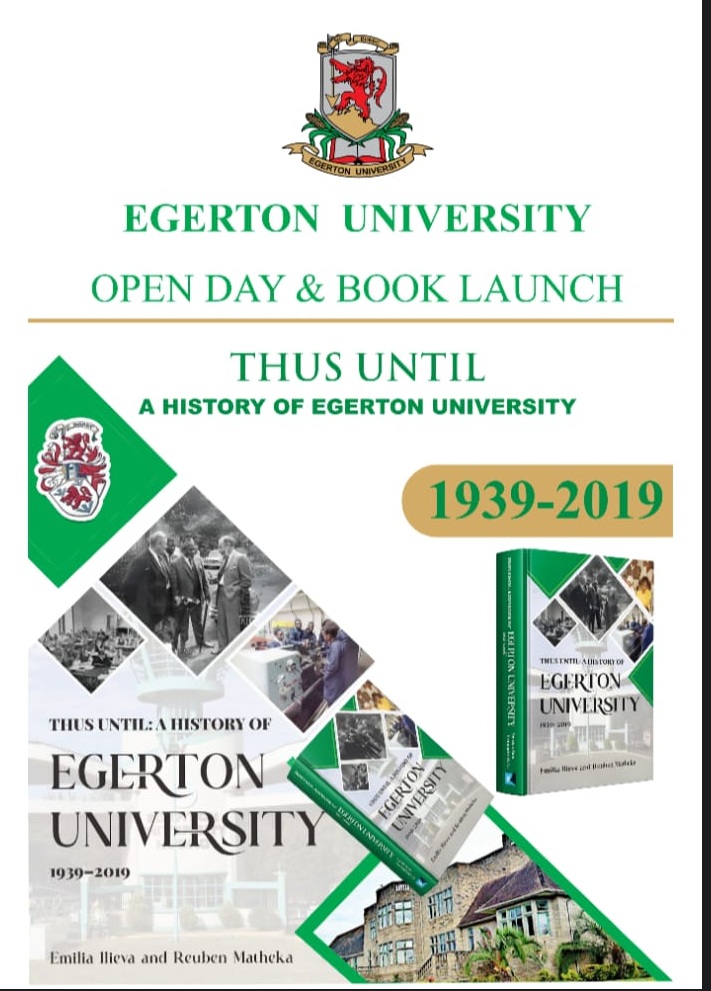
The book – Thus Until: A History of Egerton University, 1939-2019 – written by Professors Emilia Ilieva and Reuben Matheka says Lord Egerton’s key contribution to the setting up of the university which started as a farm school, was land.
The idea was however not his, but that of the colonial government, which, having been moved by his benevolence decided to name it after him.
“This naming decision created the perception that Lord Egerton was not only a benefactor, but also a founder of the school,” the book states, adding that it “is an erroneous view that has exited to this day.”
Suffice to say, some version of that “erroneous view” which has been told to many a listener, especially Egerton University students on their orientation days, is that, Lord Egerton had solely started the school with only three students in the first intake.
But the book clarifies this narrative. First it notes, the school was “opened on May 9, 1941,” and “twenty-two boys were admitted in the first intake, followed by another successful candidates in 1942.”
Even though the school opened its doors to students in 1941, the year 1939 is seen as the founding year since it is the year the colonial government took a decisive step towards the establishment of the school.
In that year, the book states, “the colonial government was about to take an important step in the development of European education in Kenya, allowing for its flexibility and diversity.” This step was being arrived at following earlier discussions and recommendations on the need to establish a farm school that would, among other things, “revitalize settler agriculture,” the book says.
The idea of starting “a school farm in general terms,” was outlined in a May 1939 meeting by the Director of Education with the Principals of the European primary schools in Nairobi, Nakuru, Eldoret, and Kitale,” the book states. The Director wanted to know if the principals had pupils who “might show interest in such an establishment for the post-primary education.”
The principals gave a node, but not before they showed their reservations for the name of the school. They said his “unfortunate wording created the impression that the school was meant for duds or mentally defectives and was therefore likely to discourage parents from sending their sons to it rather than lead to the desired backing.”
Having agreed on the need to start a farm school, a proposal was developed and presented to government for consideration, and it was strictly to be for Europeans (and at first only for boys); and specifically, be “a twin facility comprising a Training Farm and Secondary School,” the book states.
When approached for his donation of his Ngongongeri Farm, which had been seen as appropriate for the project, Lord Egerton readily obliged giving 500 acres straight away. He gave no conditions to this donation but only asked that should the project not be accomplished, the land should be handed back to him “free of any legal or other charges.”
But the book gives the impression that at no given point did Lord Egerton influence the naming of the school after him, or his estate. And even so, it notes, he was absent during the school’s preparatory period for almost a decade. He seemingly left Kenya, just after donating the land.
“Following the outbreak of the Second World War, in December, 1939, Lord Egerton travelled to England and would not see Kenya again for the next nine years,” the book says. And nowhere does it state, that he would make any follow ups with his agents back in Kenya on this school project either as way of getting updates or influencing the progress.
The government also considered other names before it arrived at the Egerton name for the school. “Throughout the preparatory period,” it states, “the farm school and training farm was variously called the Njoro Farm School; and Agricultural School, Njoro. Soon after the official opening, the Government decided to name the school, Egerton School of Agriculture.”
By donating the land, and being placed in the midst such a big education project, Lord Egerton was also fulfilling his long-held dream and interest in education. The book details how by the 1920’s he had established at least two schools in his farms for his workers’ children. The schools – Ngata and Ngongongeri primary which exist to date – may not have been set out of an “altruistic motive,” the book states. Rather, like the colonial settler he was, the schools were “a way of keeping parents on the farm.”
To date Egerton University enlivens this dream. Through its motto Sic Donec (meaning ‘Thus Until’), it also enlivens the motto of his family which the book traces to the first Baron in the Egerton line. That Baron is Sir Thomas Egerton who lived between 1540-1617. The book says he was the family’s “most renowned representative” and was highly valued by the royal family. It states that he was made a Baron by King James I who ascended to the throne on March 24, 1603. Having become a “Baron, Egerton of Ellesmere”, Thomas then introduced this phrase as the family motto. In 1610 he “was elected Chancellor of Oxford University.”
Ends…