



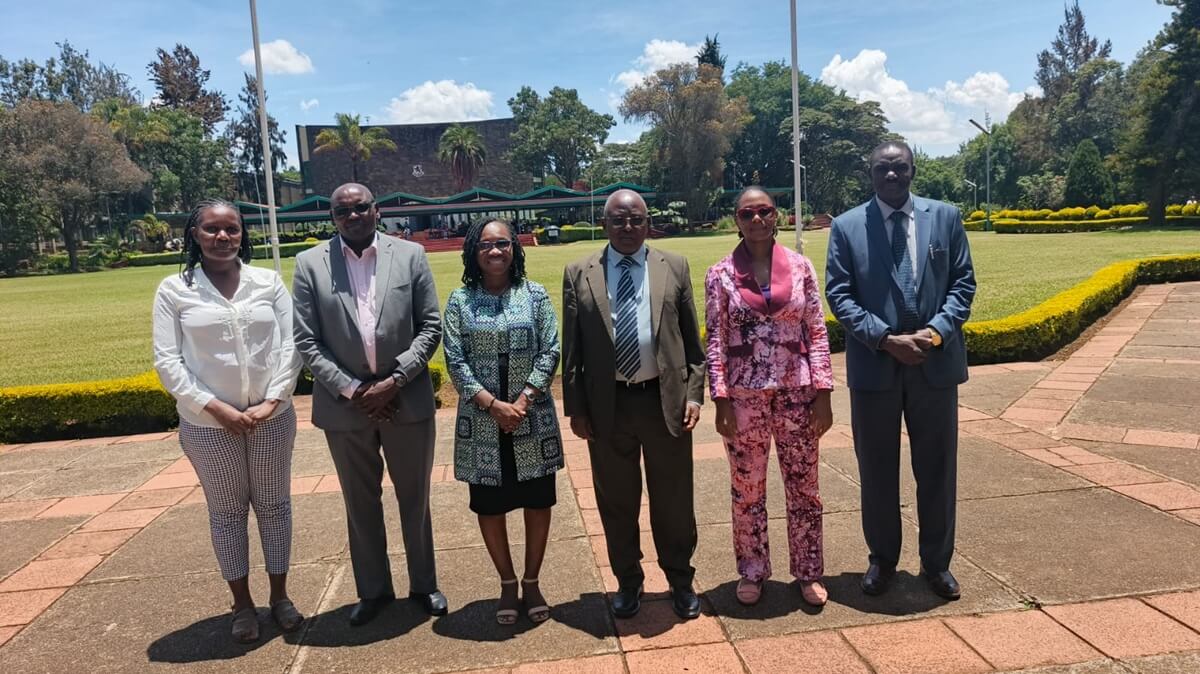
Egerton University Vice Chancellor, Prof. Isaac Kibwage, has engaged a multidisciplinary team implementing the FoodSafety4Africa initiative, reinforcing the university’s leadership in applying science to address Africa’s food safety challenges.The vice chancellor talked about effects of increased aflatoxin in maize that has affected human health.
It is important to note that of the 6 partners in Africa, Egerton is one of the strong partners. Others include Nigeria, Benin, S. Africa, Egypt and Cameroon. They are here to address food safety in the informal sector
The project is led by Principal Investigator Prof. George Owuor, Director of Research and Extension, alongside Co-Principal Investigator Prof. Paul Kimurto, Director of the Agro-Science Park.

The meeting also brought together key collaborators and stakeholders, including Dueb Banwo, Titilayo Falade of the International Institute of Tropical Agriculture, and Nancy Njeri from the Kenya Agricultural and Livestock Research Organization.
Their participation reflected the project’s strong regional and international partnerships.The discussions unpacked critical food safety risks across Africa’s informal markets.
These include weak traceability systems, pesticide residues in food and feed, and microbial contamination such as Salmonella and Escherichia coli.
The team emphasized how these hazards intersect with public health, trade, and livelihoods, particularly among smallholder farmers and informal food vendors.
Citing insights from the World Health Organization, the meeting highlighted that unsafe food contributes significantly to disease burden globally, with Africa disproportionately affected.

Prof. Kibwage underscored the need for universities to translate scientific evidence into practical interventions that communities can adopt.
The project, coordinated by IITA, leverages a systems-based model that integrates research, innovation, and policy support.
It promotes solutions such as digital traceability tools, capacity building for food handlers, and co-creation platforms that connect researchers, industry, and policymakers.
Prof. Owuor noted that the initiative is not only about identifying risks but also about designing scalable solutions that enhance food system resilience.
Prof. Kimurto added that the Agro-Science Park provides a dynamic environment for testing and scaling innovations.

This means that Egerton University is committed to advancing interactive, evidence-based approaches that strengthen food safety, protect public health, and support sustainable development across Africa.

By Kurian Musa,Communications Officer.