




By John Emeripus
Prof. Isaac Kibwage, Vice-Chancellor of Egerton University, has called on institutions to strengthen their cybersecurity measures, promote responsible digital behaviour and ensure that knowledge gained through training is translated into practical action.Speaking at the conclusion of a five-day cybersecurity training held in Nakuru on 28th August 2026, Prof. Kibwage commended the Kenya Education Network (KENET), the Internet Corporation for Assigned Names and Numbers (ICANN), facilitators and participants for their commitment to strengthening cybersecurity capacity across institutions.
Prof. Isaac Kibwage, Vice-Chancellor of Egerton University, has called on institutions to strengthen their cybersecurity measures, promote responsible digital behaviour and ensure that knowledge gained through training is translated into practical action.

Speaking at the conclusion of a five-day cybersecurity training held in Nakuru on 28th August 2026, Prof. Kibwage commended the Kenya Education Network (KENET), the Internet Corporation for Assigned Names and Numbers (ICANN), facilitators and participants for their commitment to strengthening cybersecurity capacity across institutions.
The Vice-Chancellor observed that cybersecurity has evolved beyond being solely an ICT function and has become a critical institutional responsibility. He noted that universities and other organisations increasingly depend on digital systems to manage student and staff records, finances, research, examinations, communication and other essential services. Protecting these systems, he said, is therefore vital to safeguarding institutional information and ensuring continuity of operations.
Prof. Kibwage noted that participants had been exposed to various cybersecurity threats, including phishing, ransomware, website attacks and website hijacking. He cautioned that such threats continue to evolve and are becoming increasingly sophisticated, particularly with the growing use of artificial intelligence.He therefore urged institutions to remain vigilant and continuously strengthen their systems, policies and human capacity.Prof. Kibwage challenged participants to ensure that the knowledge and skills acquired during the training do not remain confined to the workshop but are applied within their respective institutions.“Do not leave the knowledge you have gained here. Take it back to your institutions and put it into practice,” he said.

He encouraged participants to share their knowledge with colleagues through briefings, lectures, tutorials and practical sessions, noting that institutions should develop a wider pool of cybersecurity expertise rather than relying on a few trained individuals.The Vice-Chancellor further urged participants to review their institutional systems, identify vulnerabilities and recommend appropriate interventions to address them. Where additional resources are required, he encouraged them to engage management early and clearly demonstrate the risks involved and the measures needed to mitigate them.Prof. Kibwage emphasised that cybersecurity is not solely the responsibility of ICT professionals, but of every user of a digital system. He therefore called for greater awareness and responsible digital behaviour among staff and students, particularly in the use of social media and other online platforms.
He cautioned that information shared online can have long-term consequences, reminding users that content posted on the internet may resurface years later. He encouraged members of the university community to exercise caution when sharing information, images and comments, while respecting the privacy and security of others.On artificial intelligence, Prof. Kibwage acknowledged its growing potential as a valuable tool for learning, research and institutional development, while cautioning against excessive dependence on technology. He encouraged students and professionals to continue developing independent thinking, analytical skills, knowledge and effective communication.The Vice-Chancellor also encouraged participants to maintain their professional networks and relationships with KENET and one another beyond the training. He noted that a strong community of cybersecurity practitioners would enable institutions to share experiences, learn from common challenges and develop collective solutions.

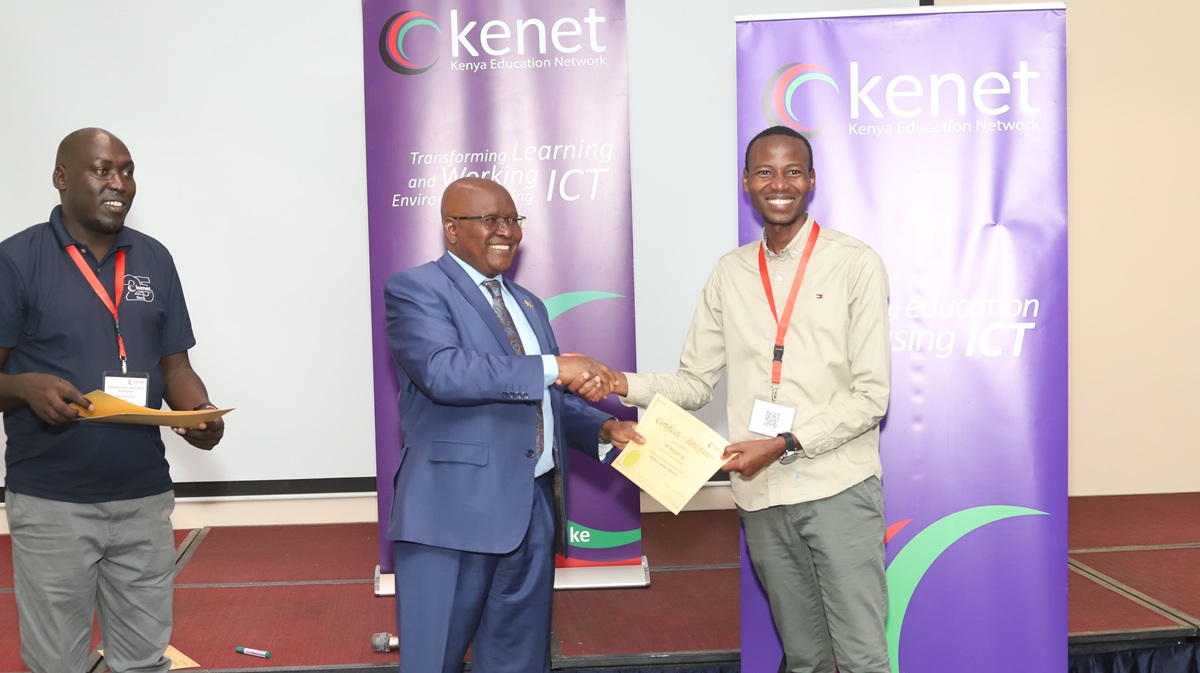
He, however, emphasised that information sharing must always respect institutional confidentiality and information-security requirements.As the training concluded, Prof. Kibwage congratulated participants on successfully completing the programme and receiving their certificates. He noted that while the certificates recognise participation and achievement, the true measure of the training would be reflected in the action taken after participants return to their institutions.He challenged them to demonstrate a clear difference between the situation before and after the training by strengthening cybersecurity systems, addressing vulnerabilities, sharing knowledge and promoting responsible digital behaviour.
Prof. Kibwage concluded by thanking KENET and ICANN for organising the training and bringing together cybersecurity practitioners from different institutions across the region. He described the workshop not as an end, but as the beginning of continued collaboration, learning, knowledge sharing and collective efforts to strengthen institutional cybersecurity.“The real work begins when you leave this workshop,” Prof. Kibwage said.