





By Kurian Musa
NAIROBI, Kenya — Kenya’s food safety architecture is under growing pressure from a cocktail of hazards ranging from aflatoxins and pesticide residues to antimicrobial resistance, heavy metals and environmental pollutants, prompting experts, researchers, regulators, farmers and industry players to call for a coordinated national response.
The call emerged at a high-level multi-stakeholder symposium held a fortnight ago at the Kenya Agricultural and Livestock Research Organization (KALRO) Headquarters in Nairobi. The landmark meeting, co-organized by KALRO, Egerton University and the International Institute of Tropical Agriculture (IITA) under the European Union-funded Food Safety for Africa (FS4Africa) project, brought together 45 key actors from research, academia, government, industry and farming communities.
The forum sought to confront persistent food safety threats across Kenya’s crop and livestock value chains—risks that experts say are being intensified by climate change, changing production systems and expanding domestic and international markets.
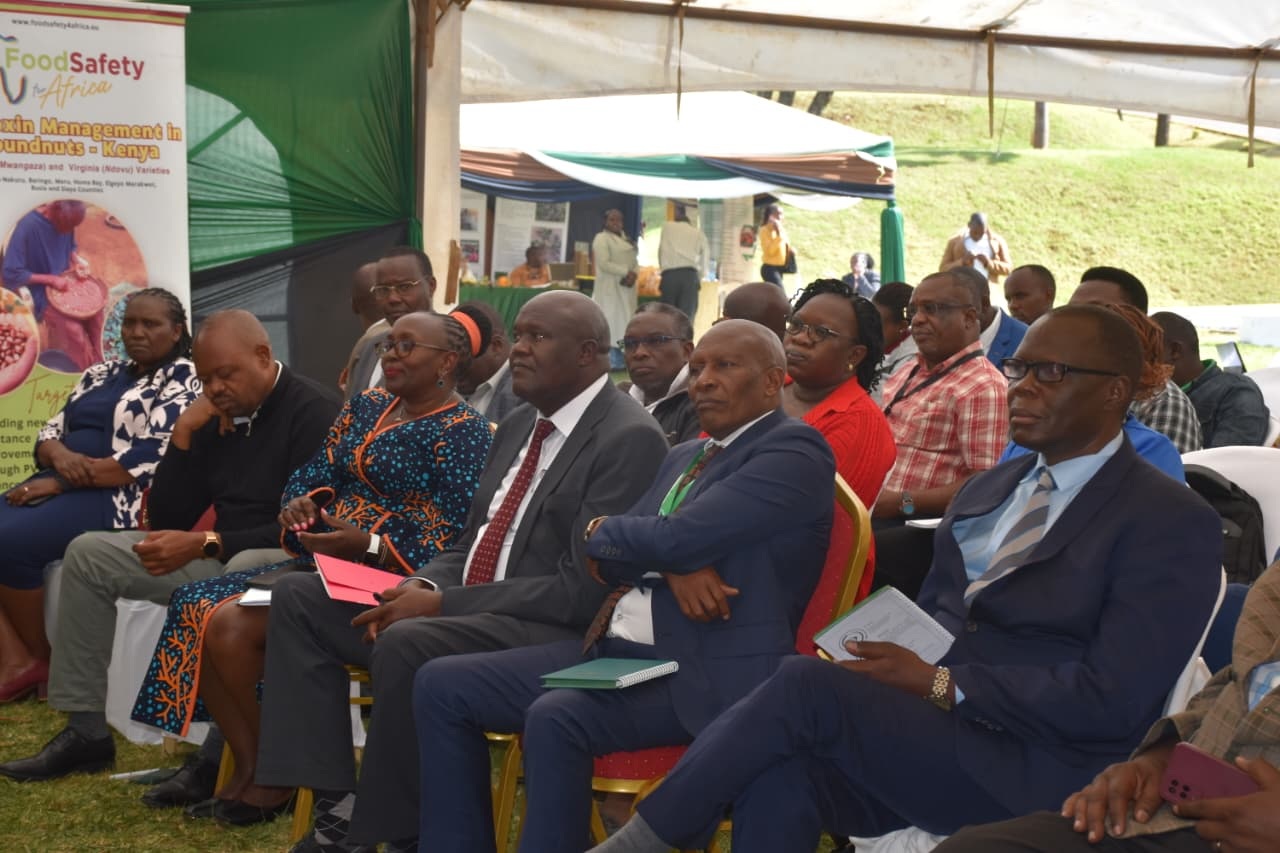
Opening the meeting, Dr. Titilayo Falade, an IITA Food Safety Scientist and FS4Africa Project Coordinator, painted a sobering picture of the continent’s food safety challenge.
“Across the continent, we continue to grapple with food safety challenges such as antimicrobial resistance, pesticide residues, mycotoxins, and heavy metal contamination in food and feed,” she said. Food, she warned, could become a source of illness and death instead of nourishment.
Yet Falade said Africa possesses the scientific knowledge, technologies and partnerships required to reverse the trend. The challenge, she argued, is moving decisively from diagnosis to implementation.
“Our focus must move ‘from burdens to solutions, safe food everywhere.’ We must concentrate on scaling solutions rather than just discussing challenges,” she said. Dr. Nancy Njeru, an expert in Crop protection from KALRO, gave a brief on Food Safety Landscape in Kenya and Globally addressing global, and Kenyan context of both the challenges and opportunities. She described the prevalence of various emerging food safety hazards including aflatoxins, pesticide residues, heavy metals, microbial contamination, and hygiene issues and its effect food systems, and global trade significantly in Kenyan and Africa. She also presented food safety, innovations including Aflasafe technology, hermetic storage technology and collaboration across stakeholders as pathways to safer food systems.
Systemic Risks Along the Food Chain
Presentations during the symposium exposed vulnerabilities stretching from farms and storage facilities to informal markets and consumers’ kitchens. Dr. Moses Olum of KALRO’s Veterinary Science Research Institute highlighted the severity of aflatoxin contamination and weaknesses in enforcement and market practices.
He observed that dog food can, in some circumstances, be subject to stricter safety controls than food intended for human consumption because dogs have a low threshold for aflatoxicosis.
The economic realities facing traders and farmers further complicate the problem. Olum noted that sellers under financial pressure may mix contaminated produce with clean grain in an attempt to reduce losses and protect profit margins.
Such practices, experts warned, can allow hazardous commodities to remain within the food chain long after contamination has occurred.
At the academic level, Prof. Bernard Aduda, Deputy Vice-Chancellor for Research at Egerton University, emphasized the need to close the gap between scientific research and community practice.
“Food safety is a major concern in Kenya. We see high pesticide residues in potatoes and heavy metals in vegetables grown along roadsides, while the people handling these foods do not always observe hygiene,” Aduda said.
He stressed that research institutions must ensure that scientific knowledge reaches the communities that need it most.
“Research must be domesticated to ensure knowledge reaches communities, and Egerton University is committed to continuing collaboration with stakeholders to collect the data required to advise national policy,” he said.
Enforcement, Politics and the Price of Food
Government officials at the meeting acknowledged that food safety is not simply a technical challenge. Politics, limited public awareness and household economics can all undermine efforts to protect consumers.

Ms. Brenda Obura of the Ministry of Health pointed to enforcement and awareness gaps.
“Food safety issues in Kenya are often undermined by politics,” she said, adding that limited consumer awareness makes public sensitization a critical priority.
She was particularly emphatic about aflatoxin control in maize.
“Maize without Aflasafe is not safe, and if it is not safe, it is not food,” she said.
Ms. Teresia Karanja of the Ministry of Agriculture and Livestock noted that consumers frequently make purchasing decisions based on affordability and appearance rather than food safety.
“Consumers often prioritize price and appearance over safety,” she said.
Karanja called for stronger government support for institutions responsible for generating food safety data, including aflatoxin surveillance.
“Institutions involved in availing data on food safety, such as aflatoxin surveillance, should be supported by the government with increased budgetary allocation,” she added.
From Research to Farm-Level Solutions
Despite the seriousness of the challenges, the symposium increasingly shifted toward practical interventions that are already showing results in farming communities.
Under the FS4Africa project, researchers at Egerton University—including Dr. Milka Wambua, Prof. Paul Kimurto and Prof. George Owuor—presented advances in developing groundnut varieties with improved resistance to aflatoxin and high levels of alpha-tocopherol, or Vitamin E.
When combined with Aflasafe, a natural biocontrol technology designed to suppress toxin-producing fungi, the interventions were reported to reduce toxic accumulation by between 80 and 90 percent.
The forum also showcased a range of technologies aimed at tackling food safety risks before produce reaches consumers. These included Aflasafe, improved groundnut varieties, hermetic PICS storage bags, humidity cards, SIMM grain moisture meters and seed preservation technologies designed to maintain seed viability while reducing dormancy.
Farmers attending the meeting provided evidence that such technologies can translate into both safer food and stronger household incomes.
Wilson Rutto, a groundnut farmer from Elgeyo Marakwet County, said the adoption of Aflasafe had improved yields and reduced post-harvest losses.
“Farmers in my area were introduced to Aflasafe by processors, and since its use, we have not witnessed grain discoloration and empty pods,” Rutto said.
He reported that his community sold 100 metric tonnes of safe groundnuts in the previous year, generating an estimated Ksh20 million (about USD120,000) by combining improved varieties with biocontrol products.
For Emily Chemweno, a farmer from Baringo County, food safety begins at home and cannot be treated solely as a requirement for accessing formal markets.
“Safety should not only be considered when it comes to market access, but also for self-consumption, as families consume the same produce they sell,” she said.
Building a One Health Response
The discussions also underscored the importance of cooperation between research institutions, regulators, private companies, agro-dealers and rural households.
Vetagro Co. Limited demonstrated low-cost post-harvest technologies, including the SIMM Moisture Meter, priced at about Ksh800, alongside hermetic storage bags designed to protect grain from moisture and deterioration.
Mr. Benson Ngigi of Aak Grow stressed that agricultural chemicals themselves are not necessarily the problem; rather, risks arise from inappropriate use.
Delegates also laid the foundation for the Kenya Food Safety Network (KFSN), linked to the broader Africa Food Safety Network. The platform is expected to bring together researchers, regulators, policymakers, industry and other stakeholders to ensure that scientific evidence informs national food safety decisions.
For Kenya, the outcome of the symposium represents more than another gathering of experts. It signals an attempt to move food safety from fragmented interventions toward a coordinated national system—one in which evidence generated in laboratories reaches farms, markets and households.
The central message from the forum was clear: protecting Kenya’s food supply will require sustained investment, stronger enforcement, informed consumers and, above all, the political will to turn available science and technology into everyday practice.
The country, experts agreed, already has many of the tools it needs. The next challenge is ensuring they reach every point where food is grown, handled, stored, traded and consumed.

“Agrochemical products are not the problem, but rather how users apply them. Misuse of chemicals drives food safety problems,” he said, advocating the principle: “Better Farming, Better Food, Better Health.”
The need for a unified response was further reinforced by Ms. Jane Kamau of IITA, who presented a One Health framework linking human, animal and environmental health.
Her proposed pathway was straightforward: “Identify Challenge + Prepare Solution + Build Knowledge + Take Action + Do It Continuously.”
Toward a National Food Safety Network
The symposium ended with a commitment to convert the discussions into a more structured national response.
Dr. Patrick Ketiem, Director General of KALRO, directed the establishment of a technical advisory team bringing together the key stakeholders represented at the forum.
“We are establishing a dedicated technical team from all key stakeholders present to advise the Agriculture Principal Secretary on Kenya’s food safety status,” Ketiem said.
“All the data needed is already available; it is time for scientists to speak out and provide evidence-based recommendations.”
Dr. Thuo Mathenge, Chairperson of the KALRO Board, reinforced the urgency of controlling aflatoxin contamination, declaring: “Mahindi bila Aflasafe si safe (Maize is not safe without Aflasafe). I declare myself the Aflasafe Ambassador.”

Delegates also laid the foundation for the Kenya Food Safety Network (KFSN), linked to the broader Africa Food Safety Network. The platform is expected to bring together researchers, regulators, policymakers, industry and other stakeholders to ensure that scientific evidence informs national food safety decisions.
For Kenya, the outcome of the symposium represents more than another gathering of experts. It signals an attempt to move food safety from fragmented interventions toward a coordinated national system—one in which evidence generated in laboratories reaches farms, markets and households.
The central message from the forum was clear: protecting Kenya’s food supply will require sustained investment, stronger enforcement, informed consumers and, above all, the political will to turn available science and technology into everyday practice.
The country, experts agreed, already has many of the tools it needs. The next challenge is ensuring they reach every point where food is grown, handled, stored, traded and consumed.

The country, experts agreed, already has many of the tools it needs. The next challenge is ensuring they reach every point where food is grown, handled, stored, traded and consumed.
The writer is a communication Officer, Directorate of Marketing and Resources Mobilization of Egerton University. Email: