


BY ERIC SINDABI
Library staff at Egerton University underwent intensive training on the application of Artificial Intelligence (AI) in modern library services during a capacity-building workshop held at the University Library’s Resource Centre in May 5, 2026.The training, titled; AI for Librarians, targeted library personnel and focused on equipping them with practical skills on the use of AI tools in research support, administrative operations, technical services, and information dissemination services within the library system. The programme also addressed ethical concerns surrounding AI adoption, including plagiarism, copyright violations, privacy, and data governance.
Facilitator Kenneth Rotich, the librarian in-charge of Digital Library Services said the workshop was part of university’s broader AI capacity-building initiative aimed at preparing staff for the rapidly evolving technological landscapes. “AI is now part of the library infrastructure capacity-building programmes for library staff globally.Infact, many universities across the world are embracing AI in their systems with the realisation that it is the destiny and reality of technological revolution, but there is a need to have policies and literacy on sustainable AI applications.”
Co-facilitator Andrew Njuguna, the in-charge Library Systems & Law Library noted that AI was transforming lives across all aspects including small business management, agribusiness, health and wellbeing, apart from professional aspects. “Over the past few decades, AI has evolved rapidly because of the advances in machine learning, big data, cloud computing, and automation technologies and it is transforming lives everywhere in the world.”
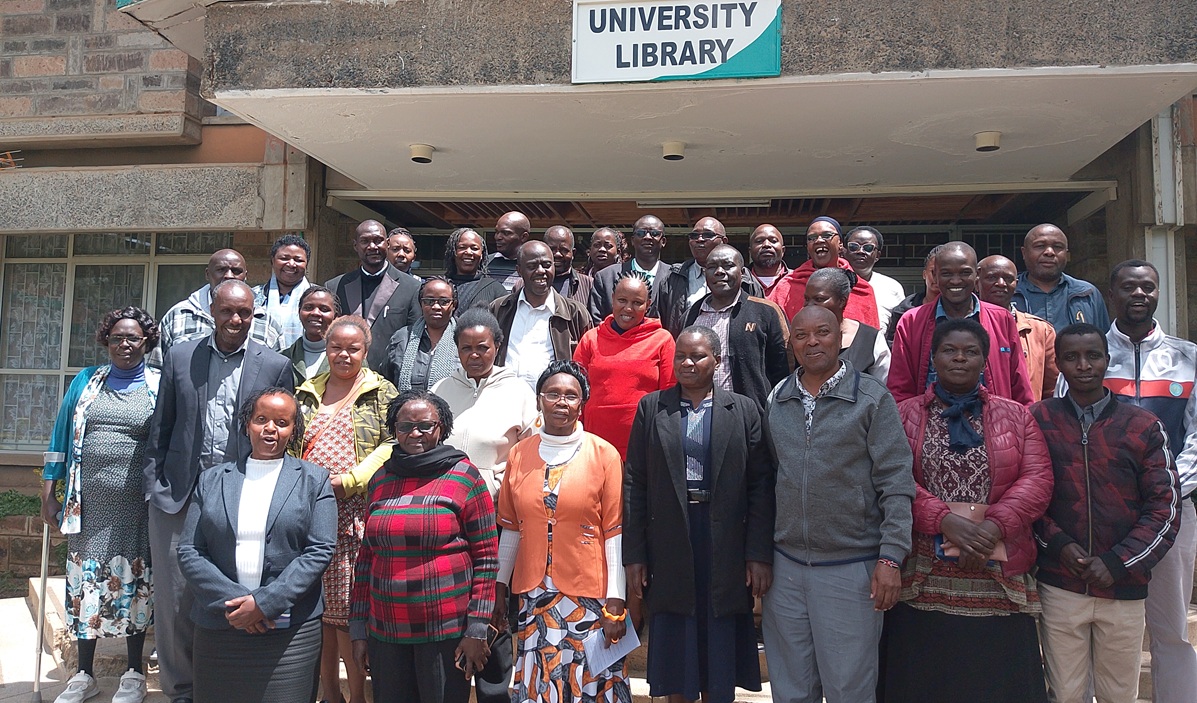
Library staff who participated in the "AI for Librarians" training pose for a group photo with Ag. University Librarian Felicitas Ratanya (left,front row).Photo/Eric Sindabi.
The one-day training explored several areas of AI integration in academic libraries, including AI tools for research planning, ethical considerations in AI applications, and practical AI utilisation in library operations. Participants were introduced to emerging AI- enabled technologies designed to enhance efficiency in information management and service delivery including AI- powered library management systems, intelligent discovery and search tools,chatbots,virtual reference assistants, automated cataloguing and metadata generation tools, optical character recognition(OCR), and AI- supported administrative and reporting systems.
These technologies can help information centres streamline administrative workflows, improve reference services, automate aspects of cataloguing and classification, facilitate information retrieval, and assist in generating reports and other institutional documents. The facilitators also demonstrated how generative AI tools such as Chat GPT, Google Gemini, Microsoft Coplot, and Semantic Scholar can support researchers in planning, literature search, synthesising and summarising research information and findings.
A significant portion of the workshop focused on the ethical implications of AI utilisation especially in academic and professional aspects. Participants were taken through copyright violations and plagiarism risks associated with generative AI systems, particularly in research and academic writing. The training also highlighted concerns surrounding data governance, privacy, consent, and data harvesting practices by AI platforms. The facilitators noted that institutions adopting AI technologies must establish safeguards to protect users’ personal and research data.
In addition, the workshop addressed the pyschocultural and labour implications involved in the growing use of AI technologies globally. At Egerton University, the programme is expected to strengthen the capacity of library staff to support students, lecturers, and researchers in navigating AI-powered information environments responsibly and effectively. The workshop concluded with calls for continued professional development programmes to ensure librarians remain informed about emerging AI trends, opportunities, and ethical challenges as universities continue integrating advanced technologies into their operations.