

Egerton University NewsLink Magazine & Journals

By Eric Sindabi
In this era of fast evolving digital technology that is a threat to conventional education and reading culture, school librarians and teacher librarians have been challenged to become champions of reading culture and critical thinking as a way of enhancing academic performance as well as career development standards among learners.
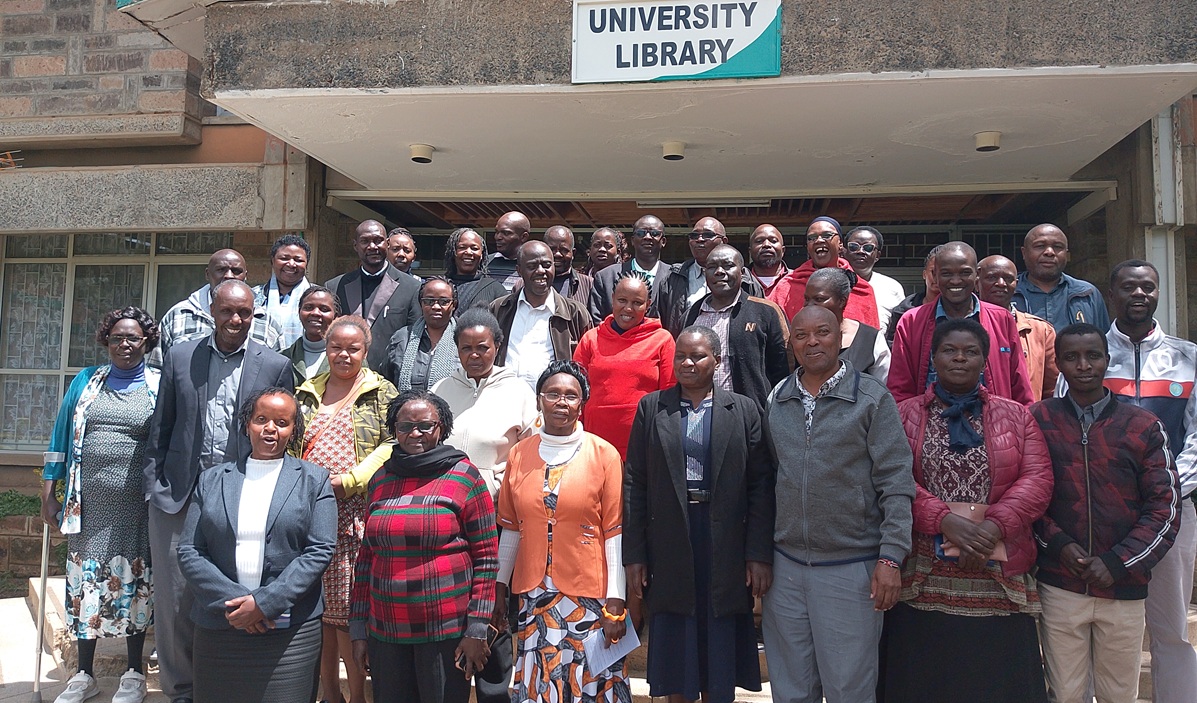
These remarks were made by Dr. Maurice Udoto, the Deputy Registrar (Academic Affairs) when he officially opened a School/Teacher Librarian’s Training held at the University Library on Thursday 21 May 2026. The one-day training was organised by the Library Community Outreach Committee and brought together school /teacher librarians in Njoro Sub County. The theme of the training was: “Inculcating reading culture”. The event is part of university’s overall community outreach goals to surrounding communities.
The Deputy Academic Registrar noted that reading culture plays a significant role in the overall academic success of learners and in preparing students for future careers. He challenged school/teacher librarians to become ambassadors of reading culture in schools through innovative library services and learner-centered programmes, observing that the rapid growth of digital technology and new media platforms had become a major challenge to critical reading and insightful learning habits among young people. He noted that excessive dependence on short-form informal digital content risked weakening learners’ concentration, analytical thinking, and reading habits.
“Libraries will still remain very relevant and important learning centres despite the ever-evolving new media technology because libraries play a major role in inculcating critical reading and thinking among learners,” said the Deputy Registrar.
He urged librarians to embrace innovative approaches that could help restore traditional reading cultures among Kenyans while at the same time integrating modern information technologies effectively in library services.
Dr.Udoto further commended the University Library for organising the outreach initiative, noting that university libraries play an important role in promoting community information literacy through outreach programmes and partnerships with schools. “Empowering school librarians with modern library management and information literacy skills will help strengthen learning institutions and improve students’ academic experiences through better access to knowledge resources.”
During the workshop, participants were taken through the fundamentals of library infrastructure and management, including planning a library building, budgeting, book acquisition processes and the factors considered when selecting reading materials. The training also covered the organization of reading materials through accessioning, classification and cataloguing, as well as storage, preservation and conservation of library resources. Participants were further guided on access and dissemination of information resources aimed at improving efficiency in school library services and enhancing learners’ access to knowledge. The librarians were also taken through how to establish book clubs as a way of developing reading culture among learners.
The training further emphasised the importance of integrating Information Communication Technology (ICT) in libraries and using online reading materials, noting that digital resources improve access to information and learning materials as well as enhancing digital literacy among learners. A recurring quote during the event was; “a school without a library is like a desert without an oasis”.
BY ERIC SINDABI
Library staff at Egerton University underwent intensive training on the application of Artificial Intelligence (AI) in modern library services during a capacity-building workshop held at the University Library’s Resource Centre in May 5, 2026.The training, titled; AI for Librarians, targeted library personnel and focused on equipping them with practical skills on the use of AI tools in research support, administrative operations, technical services, and information dissemination services within the library system. The programme also addressed ethical concerns surrounding AI adoption, including plagiarism, copyright violations, privacy, and data governance.
Facilitator Kenneth Rotich, the librarian in-charge of Digital Library Services said the workshop was part of university’s broader AI capacity-building initiative aimed at preparing staff for the rapidly evolving technological landscapes. “AI is now part of the library infrastructure capacity-building programmes for library staff globally.Infact, many universities across the world are embracing AI in their systems with the realisation that it is the destiny and reality of technological revolution, but there is a need to have policies and literacy on sustainable AI applications.”
Co-facilitator Andrew Njuguna, the in-charge Library Systems & Law Library noted that AI was transforming lives across all aspects including small business management, agribusiness, health and wellbeing, apart from professional aspects. “Over the past few decades, AI has evolved rapidly because of the advances in machine learning, big data, cloud computing, and automation technologies and it is transforming lives everywhere in the world.”
Library staff who participated in the "AI for Librarians" training pose for a group photo with Ag. University Librarian Felicitas Ratanya (left,front row).Photo/Eric Sindabi.
The one-day training explored several areas of AI integration in academic libraries, including AI tools for research planning, ethical considerations in AI applications, and practical AI utilisation in library operations. Participants were introduced to emerging AI- enabled technologies designed to enhance efficiency in information management and service delivery including AI- powered library management systems, intelligent discovery and search tools,chatbots,virtual reference assistants, automated cataloguing and metadata generation tools, optical character recognition(OCR), and AI- supported administrative and reporting systems.
These technologies can help information centres streamline administrative workflows, improve reference services, automate aspects of cataloguing and classification, facilitate information retrieval, and assist in generating reports and other institutional documents. The facilitators also demonstrated how generative AI tools such as Chat GPT, Google Gemini, Microsoft Coplot, and Semantic Scholar can support researchers in planning, literature search, synthesising and summarising research information and findings.
A significant portion of the workshop focused on the ethical implications of AI utilisation especially in academic and professional aspects. Participants were taken through copyright violations and plagiarism risks associated with generative AI systems, particularly in research and academic writing. The training also highlighted concerns surrounding data governance, privacy, consent, and data harvesting practices by AI platforms. The facilitators noted that institutions adopting AI technologies must establish safeguards to protect users’ personal and research data.
In addition, the workshop addressed the pyschocultural and labour implications involved in the growing use of AI technologies globally. At Egerton University, the programme is expected to strengthen the capacity of library staff to support students, lecturers, and researchers in navigating AI-powered information environments responsibly and effectively. The workshop concluded with calls for continued professional development programmes to ensure librarians remain informed about emerging AI trends, opportunities, and ethical challenges as universities continue integrating advanced technologies into their operations.

The University Library has exhibited 910 copies of print books for public assessment ahead of their planned disposal. This followed recommendations from the University Library Weeding and Disposal Committee. The two week long exercise, held from 23rd February to 6th March, 2026 at the Main Library and the Faculty of Arts and Social Sciences (FASS) Library, attracted many curious library users drawn from the students community, academic staff, and non-teaching staff. The objective of the exhibition was to allow readers interact with the books and give feedback whether any of them should be retained, while selecting preferred copies for personal donation.

The exercise was approved by the University Librarian Janegrace Kinyanjui, and conducted by the Preservation and Conservation Section of the University Library. The in-charge of the section Mr. Japheth Olychina said that the initiative was part of the University Library’s efforts to maintain a relevant, updated, and user-focused collection while ensuring responsible disposal of outdated or underutilized materials. “The exhibition provided a transparent and stakeholder participation weeding and disposal procedure. The Library aims at ensuring that no valuable reading materials are weeded or disposed without consulting readers, especially the academic community”, said Olychina.
The University Library weeding process and exercise is undertaken in accordance to the Library Policy and in line with the Public Procurement and Asset Disposal Act 2025 (PPADA) which was originally enacted in 2015 to implement article 227 of the Constitution which requires public procurement to be fair, transparent, competitive, and cost effective. Out of the 910 volumes, users identified 15 to be retained.

By Eric Sindabi
On Monday 2nd February 2026 the University ISO Audit team conducted a continuity Quality Management System internal audit at the University Library. During the exercise, Mr. Hezron Chwero and Mr. Elisha Otieno who represented the University ISO Audit unit held an audit session with the University Librarian Janegrace Kinyanjui, together with Faculties’ Librarians and Section Heads during the audit exercise.
The auditors emphasised that the University Library was among the key University departments and that there was a need for the department to align its procedures and documentation with client needs, as stipulated in the ISO 9001:2015 standards. “Evidence of actions taken under each documented procedure should be properly recorded”, said Mr. Chwero. The auditors further advised that follow-up on Library infrastructure and procedural requests should be evidenced through documentation, while monitoring and evaluation of the library’s quality objectives should be clearly documented.

The University ISO internal auditors Mr. Hezron Chwero(second from left) and Mr. Elisha Otieno(fourth from left) and the University Librarian Mrs.Janegrace Kinyanjui (third from left) accompanied by section heads and faculty librarians pose for a group photograph after the audit exercise./ERIC SINDABI
The auditors also noted that staff competence and abilities to perform assigned tasks in line with documented objectives and procedures must be demonstrated through verifiable evidence, in line with ISO 90001-2015 requirements for effective quality management and continued improvement of library services. Among the key areas of the library system that were reviewed during the audit exercise included procedures from across all sections of the library, customer satisfaction survey reports and compliance with the University Quality Objectives framework.
ISO 9001:2015 is an international standard for managing quality in organizations which ensures consistent provision of services and products that meet customer and regulatory requirements. In academic institutions like Egerton University, 9001:2015 helps improve administration, teaching services, research processes, and service delivery.
Egerton University is an ISO 9001:2015 certified institution where as internal audit exercises are necessary to monitor and review the Quality Management System in accordance to the certification that meets international standards. The University Library Quality Management System objectives involves; improvement of access to information resources, increasing volumes of information resources (both print and electronic),creating awareness through user education programmes,and enhancing preservation and conservation of information resources.
The main purpose of the audit exercise is to identify strengths and weaknesses in service delivery. The Library was urged to improve in areas of weakness for better service delivery.